
Speed to lead chart: what the studies show, minute by minute
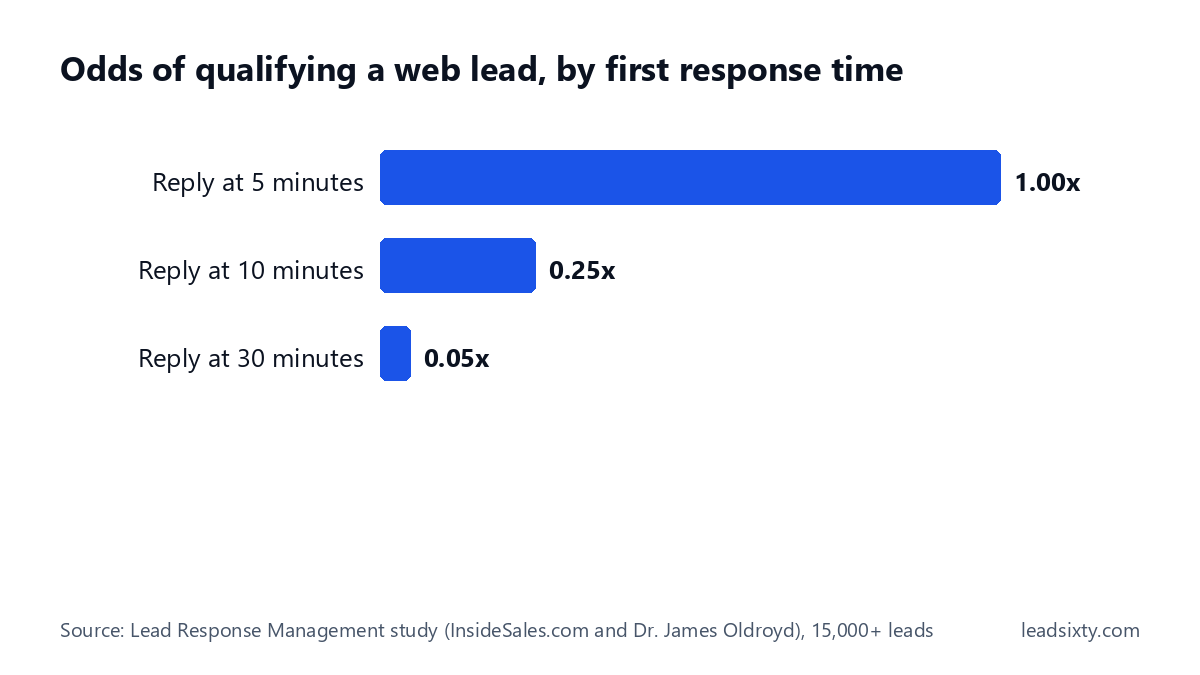
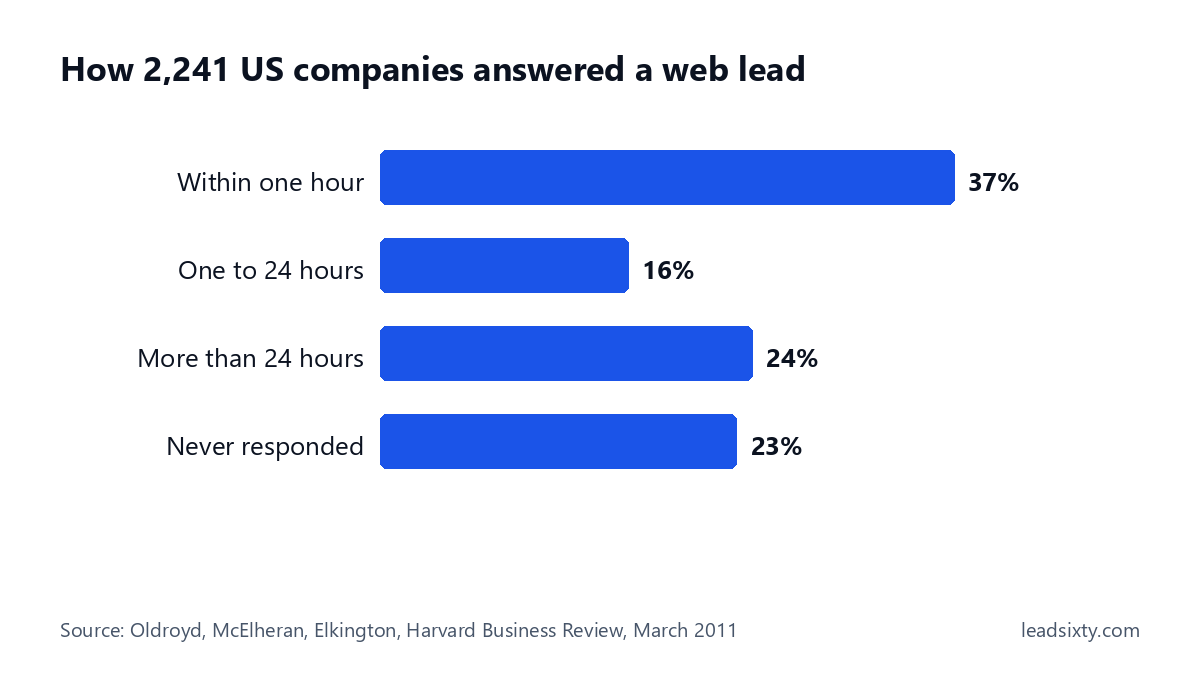
The odds of qualifying a web lead fall to about a quarter when the first reply slips from 5 minutes to 10, and to about one twenty-first at 30 minutes. Yet when 2,241 US companies were sent a test lead, only 37% replied within an hour and 23% never replied at all. Those are the two charts most people are looking for when they search for a speed to lead chart. Below are both, plus two more, each drawn only from figures we read in the study it comes from. Copy them freely with a link back.
The short version
- 5 minutes is the line. Qualifying odds drop fourfold by 10 minutes and 21-fold by 30 minutes, in the Lead Response Management study of more than 15,000 web leads.
- Most businesses are nowhere near it. In the Harvard Business Review audit, 37% of companies replied within an hour, 24% took more than a day, and 23% never replied.
- Leaks grow when nobody measures. The share of dealership leads never logged to the CRM has risen every year for six years, from 10.6% to 15.2%.
- Timing helps, speed matters more. Calls from 4 to 6 pm were 114% more likely to reach the lead than the worst hour. The first attempt still goes out the minute the lead arrives.
Chart 1: odds of qualifying a lead, by first response time
The Lead Response Management study, run with Professor James Oldroyd on three years of InsideSales.com data from six companies, analyzed more than 15,000 web-generated leads and over 100,000 call attempts. Its response-time findings, in the study's own words: the chances of qualification "dropped fourfold between 5 and 10 minutes," and there was "a 21-fold decrease in the odds of qualifying a prospect if the response time stretched from 5 to 30 minutes." The chart sets the 5-minute reply at 1.0 and shows the other two relative to it.
| First reply | Relative odds of qualifying | Study wording |
|---|---|---|
| 5 minutes | 1.00 (baseline) | Reference point for both comparisons |
| 10 minutes | 0.25 | "dropped fourfold between 5 and 10 minutes" |
| 30 minutes | 0.05 | "a 21-fold decrease ... from 5 to 30 minutes" |
Two figures from the same study are often quoted alongside these and belong in the notes. The study also reports a 100-fold difference in contact ratios, paired with the 21-fold qualification figure, and that within the first hour "contact success dropped more than tenfold, while qualification success fell over sixfold." Those use different baselines from the chart above, so we have not drawn them on the same axis. For the study finding by finding, including what it excluded, read the InsideSales study explained.
Chart 2: how 2,241 companies actually responded to a lead
In March 2011, Harvard Business Review published an audit by Oldroyd, McElheran and Elkington. In the authors' words: "We audited 2,241 U.S. companies, measuring how long each took to respond to a web-generated test lead. Although 37% responded to their lead within an hour, and 16% responded within one to 24 hours, 24% took more than 24 hours" and "23% of the companies never responded at all." The average, among companies that responded within 30 days, was 42 hours.
| Time to first response | Share of companies |
|---|---|
| Within one hour | 37% |
| One to 24 hours | 16% |
| More than 24 hours | 24% |
| Never responded | 23% |
Put chart 1 next to chart 2 and the gap is the whole point. The odds are decided in the first half hour, and most companies are not in the room for it. The article is behind HBR's paywall, but the text is short; the BYU ScholarsArchive holds the record.
Chart 3: leads that never make it into the CRM, by year
Speed to lead assumes the lead exists in a system somewhere. Foureyes' 2026 Automotive Dealer Benchmarks Report, published April 22, 2026, found that 15.2% of qualified dealership leads "were never logged to the CRM," and gives the trend: "10.6% in 2020, 11.7% in 2021, 12.4% in 2022, 13.1% in 2023, 14.1% in 2024, and 15.2% in 2025." A lead that was never logged has no response time, because nobody responded.
The same report found 62.8% of returning sales leads did not hear back from a salesperson within 24 hours, and that shoppers who called waited on hold about 73 seconds. Our car dealership follow-up guide goes through what to do about it.
Chart 4: the best hours to call a web lead
The Lead Response Management study also looked at the clock. Calling "between 4 to 6 PM maximized contact chances (114% more effective than the least effective time)," and "the 8-9 AM and 4-5 PM intervals were prime for qualifying leads, showing a 164% improvement over the least effective time (1-2 PM)." Wednesday and Thursday were the best days for making contact, 49.7% more effective than the worst day.
This is the chart people misuse. It does not say to wait until 4 pm to reply. Chart 1 says the first reply goes out within minutes, whatever the hour. Chart 4 says that when you are choosing when to make the second or third call, late afternoon and early morning beat lunchtime.
Want to know where your business sits on chart 2? On a free 30-minute Where AI Fits call we pull your real first-response times by hour and by lead source, and show you which minutes are costing you. If you are already inside five minutes around the clock, we will say so.
Book a Where AI Fits callCan I use these charts?
Yes. Each chart is built only from figures published in the source named under it, and you can copy the images below into a deck, a post or a training doc with a link to this page. If you need the numbers rather than the pictures, the tables above are the same data.
- Chart 1 as an image (1200 by 675)
- Chart 2 as an image (1200 by 675)
For the full research write-up, including follow-up cadence data and what speed to lead does not measure, see the speed to lead guide. To turn the charts into a number for your own business, the lead leak calculator sizes the share of your lead budget that waits more than an hour.
Questions about the speed to lead data
What does the speed to lead chart show?+
Where does the 21x speed to lead statistic come from?+
What is the 100x speed to lead figure?+
How fast do companies actually respond to leads?+
What is a good speed to lead?+
Can I use these charts in my own presentation?+
- Lead Response Management Study (InsideSales.com with Dr. James Oldroyd). Three years of data from six companies, more than 15,000 leads and over 100,000 call attempts; fourfold decrease 5 to 10 minutes; 21-fold decrease 5 to 30 minutes; 100-fold contact ratio; tenfold and sixfold decreases within the first hour; best hours and days. leadresponsemanagement.org
- Oldroyd, McElheran, Elkington. "The Short Life of Online Sales Leads." Harvard Business Review, March 2011. Audit of 2,241 US companies. Figures read in the article text. hbr.org; archive record at BYU ScholarsArchive
- Foureyes. "2026 Automotive Dealer Benchmarks Report," April 22, 2026. Unlogged leads 2020 to 2025; 62.8% of returning leads not contacted within 24 hours; about 73 seconds on hold. foureyes.io
Published September 20, 2026. Every figure was read on its source and checked again before publishing; see how we research and write. Found an error? Email hello@leadsixty.com.
The odds are decided in the first five minutes. Be in the room.
Book a free 30-minute Where AI Fits call. We look at where your leads come from, how long each source waits for a reply, and what it would take to answer all of them inside the window, and we tell you honestly if you already do.
Book a Where AI Fits callOr read the full speed to lead guide.